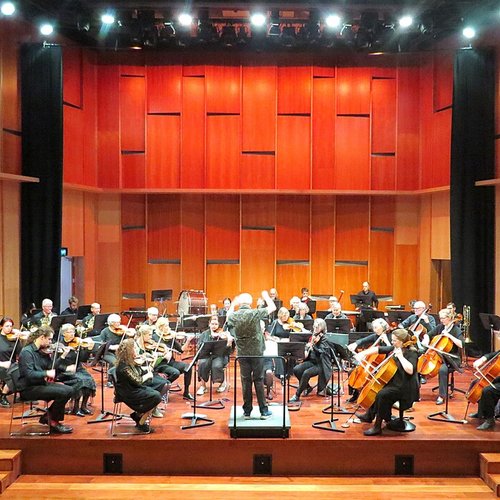
Resonance presents a concert of orchestral suites by composers from France, Germany & Finland.
Claude Debussy’s Petite Suite was completed, in its original version for piano duet, by the twenty-six-year-old composer in 1889. Henri Büsser’s 1907 orchestration enhances the insinuating decadence of Debussy’s tuneful and seductive atmosphere, where countesses and rogues, priests and knights, engage in flirting, dreaming and unconsummated temptation.
Like Debussy’s Petite Suite, Gabriel Fauré’s 1919 Masques et Bergamasques was influenced by the poetry of Paul Verlaine, the commedia dell’arte, and the suggestive frivolity of paintings by Watteau and Fragonard. Fauré’s music also shares Debussy’s evocative and nostalgic character.
The same composer’s Dolly Suite is more genuinely innocent in character. Again, like Debussy’s Petite Suite, the Dolly Suite was originally written for piano duet and orchestrated in 1906 by Henri Rabaud. Its evocative scene painting makes us realise that, although ostensibly written to entertain a five-year-old child, it was also written for everyone.
Also originally conceived as an entertainment for children, Engelbert Humperdinck’s Hansel and Gretel resonates with adults as well and has become one of the most successful fairy-tale operas ever created. The composer was a protégé of Wagner, and the overture is flavoured with the sophisticated musical style of Humperdinck’s mentor while maintaining a charm and lightness that is entirely his own. The overture also acknowledges the darker side of the Grimm Brothers’ story but presents it with grace and humour.
In 1898 Jean Sibelius wrote incidental music for King Christian II, a historical play by the Swedish writer Adolf Paul. The composer immediately extracted a suite of five pieces that became his first published orchestral music. The suite’s atmospheric Nocturne was originally an entr’acte, as was the fiery Ballade depicting political turmoil. A yearning string Elegy and a rustic Musette precede an elegant Serenade which was originally the prelude to Act III of the play. This gracious and immediately appealing music has many hallmarks of Sibelius’ later masterpieces – moving, dramatic, colourful and original.