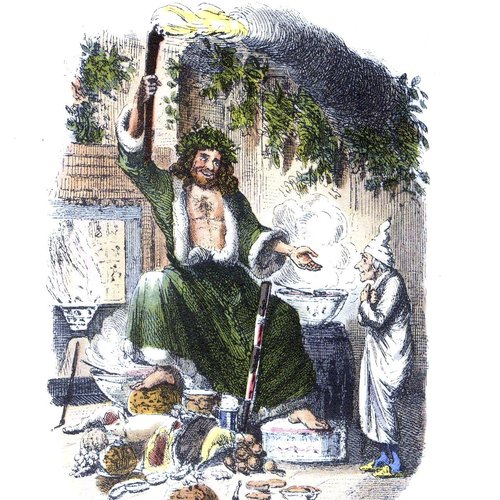
‘Change Scrooge, you need to change’ the ghosts roar. ‘Feed me, feed me’ the children plead. ‘What can I do?’ whimpers Scrooge, facing the tombstone of his imminent demise, an epitaph to his self-serving ways.
Charles Dickens’s dramatic and heart-warming allegory of a miser’s transformation has captivated readers since its first publication in 1843 (the poster pictures and typography style are drawn from this). It was Dickens’s pamphlet for the wealthy but advocating for the poor, echoing his own childhood, railing against the poverty endemic in his home town London, and written in the hopes of securing income to feed his family of five during the ‘hungry forties’ of Corn Laws and unforgiving Poor Laws.
His tale has never been out-of-print. Its themes of individual greed and societal
inequality remain relevant, as does the pressing need for the antidotes of good will and generosity Dickens’s ‘spirit of Christmas’ extols.
Philip Norman’s much-loved musical version of ‘A Christmas Carol’ has undergone its own transformations since first composed as a synthesised ballet score for Russell Kerr and Southern Ballet in 1990. Of this, the Press reviewer, Timothy Jones wrote: ‘I can give only a suggestion of the sheer individuality and happiness of this music. It is on no occasion pompous or clever. It is unashamedly approachable but at the same time it is absolutely professional.’
An operatic version, with libretto by the composer, was commissioned by Canterbury Opera in 1993, and an orchestral ballet version by the Royal New Zealand Ballet in 2000. Philip’s music also exists as an orchestral suite, but is presented here, and for the first time, as a concert entertainment for choir and soloists. This transformation was inspired by successful productions in 2023 and 2024 by Toi Toi Opera and features some of that company’s soloists.